
NdFeB vs Ferrite: How to Choose the Right Magnet Material
One is the strongest magnet money can buy, the other the cheapest per unit of field. Three questions decide which one your design actually needs.
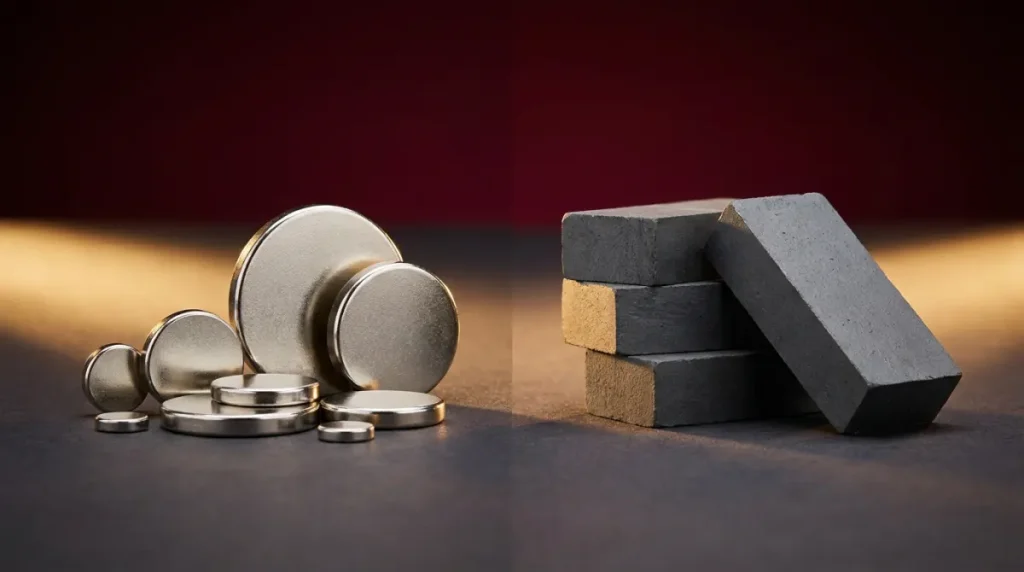
Nine out of ten RFQs we receive come down to a choice between two materials: sintered neodymium (NdFeB) and ferrite (ceramic). One is the strongest permanent magnet you can buy; the other is the cheapest per unit of field. Neither is “better” — they solve different problems, and picking wrong costs real money in both directions.
The head-to-head numbers
| Property | Sintered NdFeB | Ferrite (Y30–Y35) |
|---|---|---|
| Remanence Br | 1.17–1.47 T | 0.38–0.42 T |
| Energy product BHmax | 263–422 kJ/m³ | 26–34 kJ/m³ |
| Strength per volume | ~10× ferrite | baseline |
| Max working temp | 80 °C (N) – 150 °C (SH) | ~250 °C |
| Corrosion | Needs coating | Inherently immune |
| Relative cost per kg | High | Low |
Read the last three rows as carefully as the first three — they decide more projects than raw strength does.
When NdFeB wins
- Space is the constraint. Compact motors, sensors, headphones, latching mechanisms — when every millimetre matters, nothing touches neodymium. See our grade guide for how strong each step gets.
- Weight is money. Anything that moves — from drones to handheld tools — pays for every gram. NdFeB delivers the same force at a tenth of the mass.
- Performance sells the product. A speaker that sounds fuller, a clasp that snaps with authority: user-perceptible force is a feature.
When ferrite wins
- Cost per newton. If the design has room, ferrite delivers holding force for a fraction of the price — the eternal choice for separators, chip collectors and large hold-downs.
- Heat. Ferrite laughs at 200 °C where even SH-grade neodymium retires. Oven doors, engine-bay sensors, industrial motors with hot spots.
- Wet, salty, chemical environments. Ferrite is a ceramic oxide — it simply cannot rust. NdFeB needs plating, and every coating is a wear item in the wrong environment.
- Demagnetization resistance in motors. Ferrite tolerates opposing fields gracefully, which is why huge numbers of automotive DC motors still run on it.
The decision in three questions
- Does it fit? Sketch the ferrite solution first. If the geometry works, ferrite usually wins on total cost.
- How hot? Above 150 °C, NdFeB is out of the running entirely; between 80–150 °C it needs (pricier) H/SH grades — which erodes its cost case.
- What is the environment? Salt spray, moisture or chemicals shift the balance toward ferrite, or force epoxy-class coatings on NdFeB.
Still torn? This is literally our day job. Send both versions of your idea and we will quote them side by side — browse the NdFeB range and ferrite range to see typical formats.
FAQ
Is neodymium always the “premium” choice?
No. Above 150 °C or in corrosive service, ferrite is not the budget option — it is the correct one. Premium means fit for purpose.
Can I just replace a ferrite magnet with a smaller NdFeB one?
Often yes, but not by guesswork: the magnetic circuit, pole area and working point all change. Give us the original part and the goal, and we will engineer the swap properly.
Why did my datasheet list both materials with the same pull force?
Pull force depends on geometry as much as material. A big ferrite block and a small NdFeB disc can match on force while differing wildly in size, weight, temperature limit and cost.