
Neodymium Magnet Grades Explained: N35–N52
What the N number really means, why N52 is not always the right answer, and how M/H/SH suffixes buy you temperature headroom.
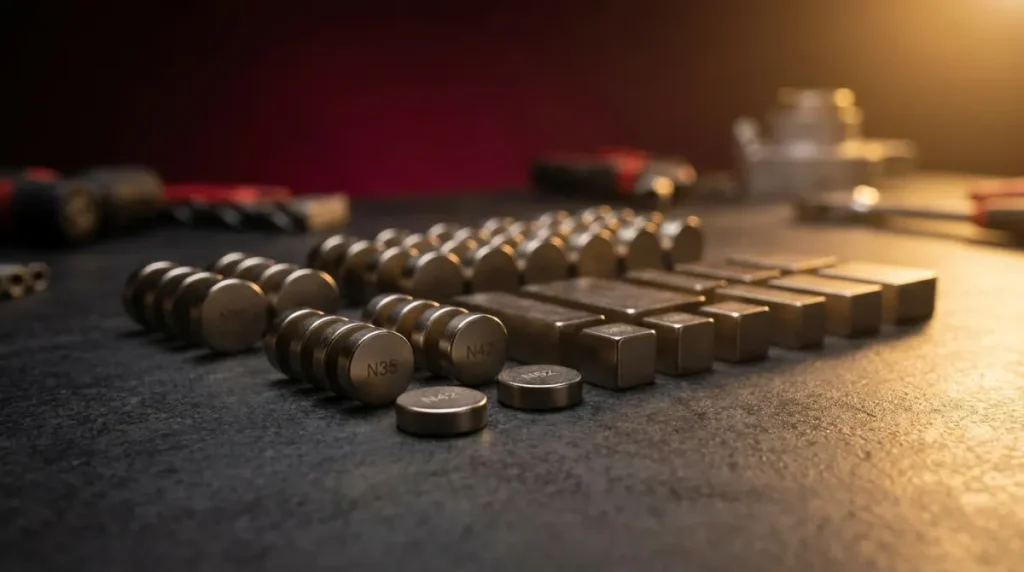
Every sintered neodymium magnet we ship carries a grade — N35, N42, N52. That little code answers the first question every buyer asks: how strong is it? But it also hides two more answers most datasheets never explain: how expensive it is, and how easily it gives up in heat. This guide decodes all three.
What does the “N” number actually mean?
The number after N is the magnet’s maximum energy product in MGOe (mega-gauss-oersteds). An N42 magnet stores roughly 42 MGOe of usable magnetic energy per unit volume; an N52 stores about 52. That is why two magnets of identical size can behave very differently: the higher grade packs more energy into the same millimetres.
Energy product is calculated from two more fundamental numbers you will meet on every datasheet: Br (remanence) and HcJ (intrinsic coercivity). Br sets the strength; HcJ sets the stubbornness.
The N35–N52 grade table
Typical room-temperature values for the sintered NdFeB grades we produce:
| Grade | Br (T) | BHmax (kJ/m³) | BHmax (MGOe) | Max working temp* |
|---|---|---|---|---|
| N35 | 1.17–1.22 | 263–287 | 33–36 | 80 °C |
| N42 | 1.29–1.32 | 318–342 | 40–43 | 80 °C |
| N45 | 1.32–1.38 | 342–366 | 43–46 | 80 °C |
| N48 | 1.38–1.42 | 366–390 | 46–49 | 80 °C |
| N52 | 1.42–1.47 | 398–422 | 50–53 | 80 °C |
*For standard N-series at typical geometries; thin magnets in open circuits demagnetize earlier.
Higher grade ≠ always better
N52 is roughly 40 % stronger than N35 in the same size — but it is not automatically the right choice:
- Cost. Higher grades use more premium rare-earth alloy and yield lower in production, so price climbs faster than strength.
- Temperature. The highest-Br grades have the least thermal headroom. An N52 that works beautifully on a desk can quietly lose flux inside an 85 °C motor housing.
- Brittleness and machining. Grade barely changes mechanical behaviour, but pushing strength instead of rethinking geometry often costs more than a small size increase would.
Our rule of thumb from years of quoting: specify the field you need at the working point, not the biggest number on the chart. Frequently a cheaper N42 one millimetre thicker beats an N52 on both cost and stability.
What about temperature? Meet M, H and SH
When the working temperature climbs past about 80 °C, standard N grades start to lose flux irreversibly. That is what the letter suffixes solve — same idea, more coercivity.
M-series (38M–52M) is rated to 100 °C, H to 120 °C and SH to 150 °C. The suffix buys you HcJ — resistance to demagnetization — at a small premium in cost and a small sacrifice in Br.
How to pick a grade in practice
- Fix the geometry first. Available space usually constrains more than grade does.
- Know your real temperature. Not the room — the magnet’s spot inside the device, at full load, in summer.
- State the field or force you need at the working distance. We can then calculate backwards to the most economical grade.
- Send a drawing. Tolerances, coating and magnetization direction round out the specification.
Browse our neodymium magnet range or see a concrete example like the N52 disc magnet. If you are unsure between two grades, send us the application — quoting both takes us minutes.
FAQ
Is N52 the strongest neodymium grade?
N52 is the strongest widely stocked grade. Higher grades exist and production keeps advancing, but availability, price and thermal limits make N52 the practical ceiling for most designs today.
Do neodymium magnets weaken over time?
At room temperature and within rated conditions, sintered NdFeB loses only a fraction of a percent per decade. Real-world losses almost always come from heat, corrosion or opposing fields — not age.
Can the same size be made in different grades?
Yes. Grade is a material property, independent of shape. The same 20 × 5 mm disc can be pressed from N35 through N52 — that is exactly how you trade strength against cost without touching the design.