
MagSafe Explained: The Magnet Ring Inside Your Phone
A circle of paper-thin arc magnets that finds its own alignment. The anatomy, the manufacturing reality, and the accessory gold rush.
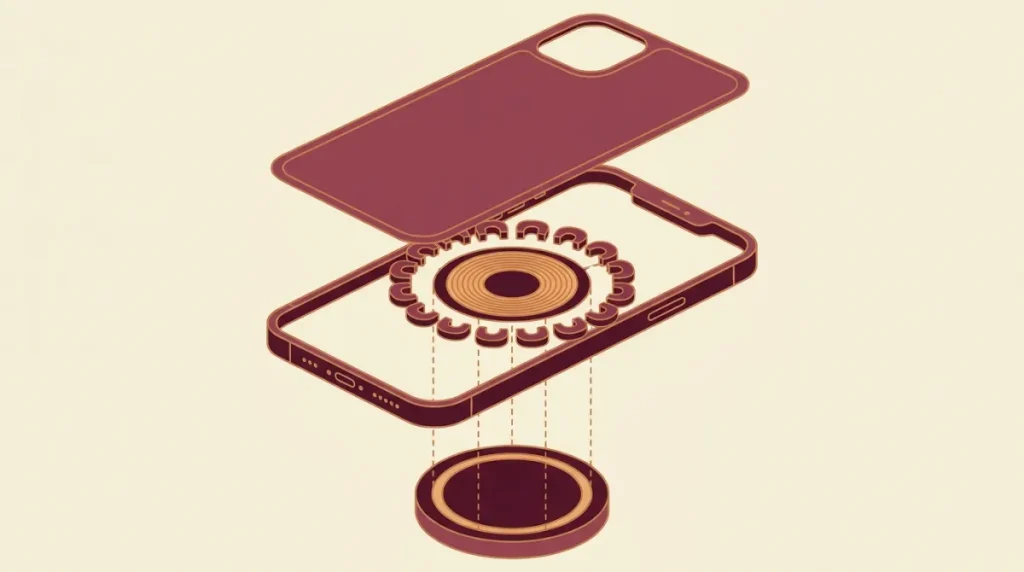
When Apple revived the MagSafe name in late 2020, it put a ring of magnets in a hundred million pockets — and quietly created a new component category. Whatever brand of phone or accessory you build for, the design pattern is now everywhere: a circular magnet array that finds its own alignment. Here is what is actually inside, and what it takes to manufacture.
The anatomy of the ring
The magnetic attachment system is an array of small arc-segment magnets arranged in a circle around the wireless charging coil, with a straight “orientation” bar nearby. Each arc is magnetized through its thickness, with polarity alternating in a defined pattern around the ring. An accessory carries a mirror-image ring, so N faces S all the way around: rotationally self-centering, orientation-keyed, and strong in shear.
Why a ring of small arcs beats one big ring
- Thickness is the whole game. Phones budget fractions of a millimetre. Many small arcs, individually magnetized, produce more usable attachment force per micron of thickness than a single monolithic ring.
- Polarity coding. Alternating segments make the attachment click into the correct rotation — the pattern is a mechanical key written in poles, the same trick our magnetization directions guide describes for multipole parts.
- Shear strength where it counts. The alternating pattern resists sliding — exactly the failure mode of a phone slipping off a car mount.
The manufacturing reality
| Requirement | Typical spec |
|---|---|
| Arc segments | N50–N52, ~0.35–0.7 mm thick, ground both faces |
| Tolerance | ±0.02–0.03 mm on thickness |
| Consistency | Per-segment flux windows; one weak arc unbalances the ring |
| Coating | Thin NiCuNi; every micron of coating is thickness budget too |
| Assembly | Segments supplied loose or pre-fixtured on adhesive carriers |
These are the thinnest production magnets most factories ever grind. Thin parts also sit at the self-demagnetization edge we described in why magnets lose strength — grade and geometry must be chosen together, not separately.
The accessory gold rush
The ecosystem side — mounts, wallets, chargers, stands, battery packs — is where most of our inquiries come from. An accessory ring has more freedom: slightly thicker arcs, cost-optimized grades, sometimes a steel ring assisting. The constant is the pole pattern, which must mate with the phone exactly. We supply matched arc sets and complete rings to accessory makers from prototype runs upward — send your stack-up, or browse the NdFeB range.
FAQ
Do attachment magnets interfere with wireless charging?
No — they surround the coil rather than sit inside it, and static fields do not couple into the charging induction. Alignment actually improves charging efficiency by centering the coils.
Are these rings dangerous to credit cards?
Magnetic stripe cards dislike close contact with any strong magnet; chip functions are unaffected. Wallet accessories position shielding accordingly — part of the accessory designer’s job.
Can other phones use the same principle?
Yes — the pattern is physics, not a proprietary lock. Cases with embedded rings retrofit the behaviour onto any phone, which is precisely what half the accessory market ships.