
Magnetization Directions Explained: Axial, Diametric, Multipole
Identical magnets behave like different components when magnetized along different axes. The three directions, what each is for, and the rule that saves bad batches.
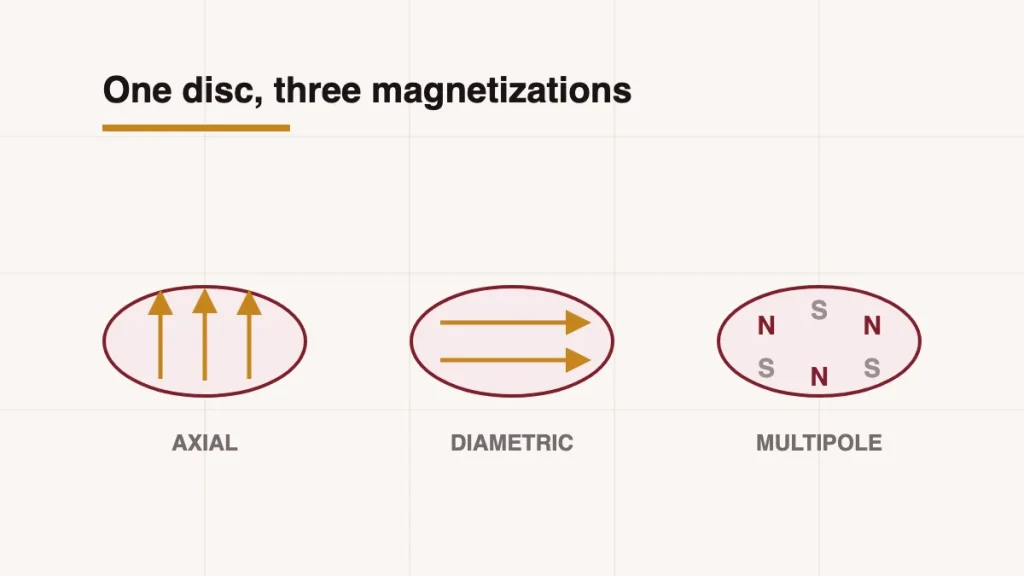
Two magnets can share identical material, grade, size and coating — and behave like completely different components, because they were magnetized along different directions. Magnetization direction is the least visible line on a magnet drawing and one of the most consequential. Here are the three that cover nearly every application.
Axial: through the thickness
Poles on the two flat faces — the default for discs and blocks. Flux exits one face, loops around, enters the other. It is the direction for holding, latching, sensing proximity and most everyday jobs. If a drawing arrives without a direction marked, axial is almost always what was meant — but we still ask, because “almost” has bitten people.
Diametric: across the diameter
Poles on opposite sides of the cylinder wall. Spin a diametrically magnetized rod and the external field rotates with it — which is precisely what rotary applications want: small motor rotors, magnetic couplings, stirrers, and rotary position sensing. The same geometry that is useless for face-holding is perfect for turning.
Multipole: many poles on one part
Alternating N-S-N-S sectors around a ring face or circumference. Multipole rings feed encoders a clean repeating signal, give steppers and BLDC rotors their pole count, and drive the click-feel in control wheels. Pole count and pole accuracy are set by the magnetizing fixture — a genuine piece of factory know-how, since a fixture exists per pole pattern.
Three rules that save redesigns
- Direction must be decided before pressing. Sintered NdFeB is oriented during pressing; a finished axial blank cannot become a diametric part later. It is a manufacturing property, not a post-process.
- Direction changes the field map, not the “strength”. Same grade, same volume — but where the flux goes, and therefore what force you get at which surface, changes completely.
- Mark it on the drawing. One arrow and, for multipole, a pole map. That line prevents the most avoidable bad batch in this industry.
Not sure which direction your mechanism wants? Describe the motion — hold, slide, rotate, count — and we will mark the arrow with you. Formats across the range are in our neodymium catalog.
FAQ
Can one magnet be magnetized in two directions at once?
Not in one solid piece — domains follow one orientation axis. Assemblies combine differently magnetized parts to sculpt fields; that is a design service we provide.
How do I check the direction of a magnet on my desk?
A second known magnet or a compass reveals it in seconds: find where attraction is strongest and how poles sit. A gauss meter maps it precisely.
Does multipole cost more?
The part itself, marginally. The fixture is the real variable: standard pole patterns quote like normal parts, custom pole counts add one-time tooling.