
Wireless Charging and Magnets: How Qi Alignment Works
Wireless charging is really alignment-sensitive charging. How centring rings, cradle pucks and sensing magnets make induction actually work.
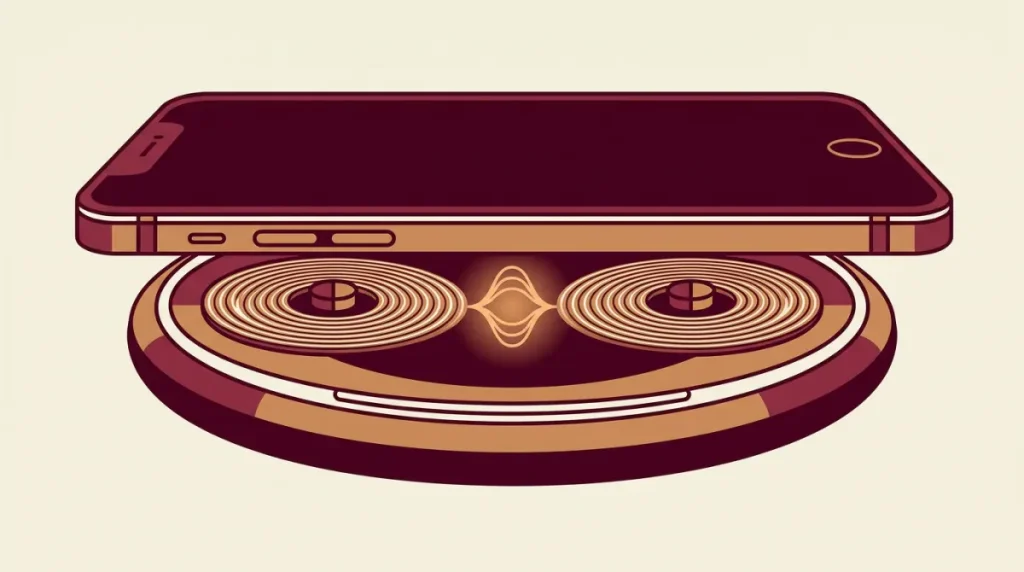
Wireless charging has a dirty secret: it is really alignment-sensitive charging. Two coils must overlap almost perfectly, or efficiency collapses into heat. For a decade the industry answered with bigger coils and multi-coil pads; the elegant answer that finally stuck is simpler — let magnets do the aiming.
Why coil alignment is everything
Qi charging is a transformer with an air core: the pad’s coil induces current in the phone’s coil across a few millimetres. Displace the coils and coupling drops steeply — a centimetre of offset can cut delivered power sharply while the loss turns into warmth. Every misaligned overnight charge is slower and hotter than it should be. Charging pads cannot see; magnets can feel.
Three magnet jobs inside the ecosystem
- Centring rings. The pattern popularised by MagSafe-style attachment rings: arc segments around both coils pull the pair into near-perfect overlap and hold it there — even on vertical stands and car mounts, where gravity votes against you.
- Attraction pucks in earbud cases. The charging case, itself charged wirelessly, uses tiny disc magnets to seat the case in the right spot — the same cradle logic as inside TWS cases, one level up.
- Foreign-object and lid sensing. Small magnets plus reed or Hall elements tell chargers a device (not keys or a coin) has arrived — safety and standby power both improve.
Magnetics that coexist with induction
Putting permanent magnets next to an induction coil sounds like asking for trouble; done right, it is not:
- Static fields do not couple. The 100–360 kHz AC induction sees a permanent magnet as inert; only geometry matters.
- But conductive and lossy paths do. Magnet placement must avoid intercepting AC flux, or eddy heating appears — the ring-around-the-coil layout exists precisely to stay out of the induction path.
- Heat budget is shared. Charging warms everything; alignment magnets in a warm device need sensible temperature classes — our temperature guide applies verbatim.
Specs we see on wireless-charging RFQs
Thin arcs and rings (0.4–1 mm), N48–N52, tight thickness tolerance, clean thin plating, per-lot flux consistency — plus, uniquely often, matched sets: device ring and accessory ring quoted together so the mated force lands in a target window. That last habit saves weeks of iteration; bring both sides of your design and we will quote them as a pair.
FAQ
Does the magnet ring slow down charging?
No — alignment improves real-world charging speed by keeping coupling high. The ring sits outside the flux path, contributing no loss of its own.
Why did pads without magnets need multiple coils?
To cover placement error: three overlapping coils let electronics pick whichever aligns best. Magnetic centring solves the same problem with less copper and cost.
Will stronger alignment magnets always feel better?
Only to a point — attachment must balance holding security against one-hand removal. Force windows, not maximum force, are the design target.