
Ferrite (Ceramic) Magnets: Composition, Grades and When to Use Them
The least glamorous magnet material and the most shipped one. Y30/Y35 numbers, the quiet virtues, and designing around the two real weaknesses.
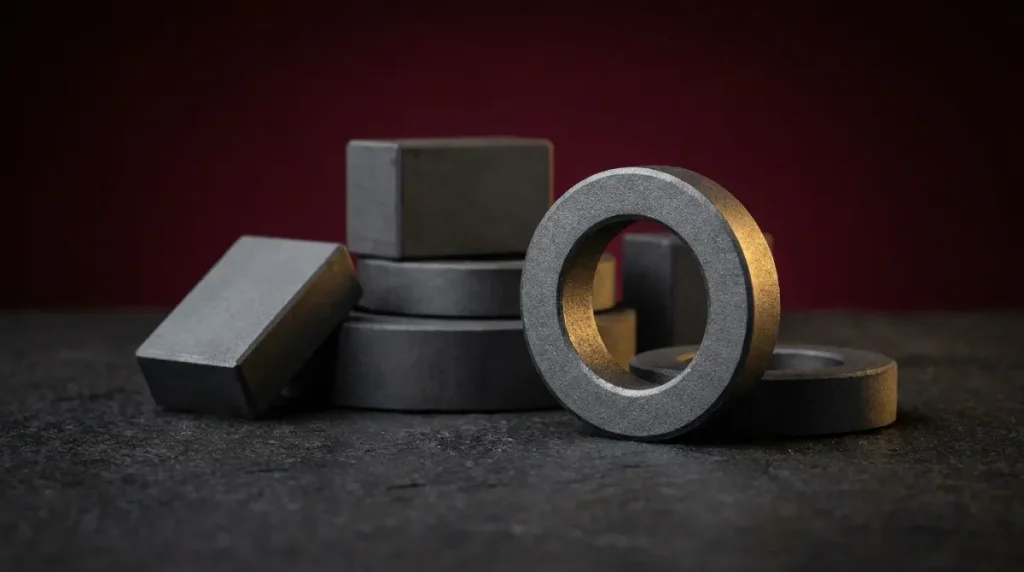
Ferrite is the magnet world’s least glamorous material and its most shipped one. By tonnage, these humble dark ceramic blocks outsell every rare-earth magnet combined — because for a huge share of real applications, unglamorous is exactly what the job requires. This is the full profile of the workhorse.
What ferrite actually is
Hard ferrite is a ceramic: iron oxide fused with strontium (or barium) carbonate, milled, pressed and sintered much like technical porcelain. No rare earths, no strategic metals, no coating required — the material is already an oxide, so corrosion has nothing left to do, a point our coatings guide could only envy.
The grades: Y30, Y35 and friends
| Grade | Br (T) | HcJ (kA/m) | BHmax (kJ/m³) |
|---|---|---|---|
| Y30 | 0.37–0.40 | 180–220 | 26–30 |
| Y30BH | 0.38–0.40 | 223–235 | 27–30 |
| Y35 | 0.40–0.42 | 175–210 | 30–34 |
Yes — Br sits at barely a third of NdFeB’s, the honest gap behind the “10× weaker” shorthand from our material comparison. Read the trio the usual three-numbers way and two quieter virtues appear: coercivity that shrugs at opposing fields, and properties that barely blink from −40 to +250 °C.
Where ferrite simply wins
- Cost-ruled force. Separators, chip collectors, hold-downs, closures — where there is room, ferrite delivers newtons for pennies.
- Hot environments. 200 °C+ service where even SH-class NdFeB has retired.
- Wet, salty, chemical service. No coating to fail means no coating-failure mode. Twenty-year outdoor products choose ferrite by default.
- Motors that must never demagnetize. Automotive auxiliary motors run ferrite by the hundreds of millions for its opposing-field tolerance.
Designing with the weaknesses
Two matter. Brittleness: ferrite chips more readily than coated NdFeB — corners want chamfers and assembly wants care. Cold coercivity dip: unusually, ferrite’s HcJ drops at low temperature, so deep-freeze motor applications check the −40 °C corner, the mirror image of NdFeB’s hot-side worry. Both are design conditions, not defects.
We press and grind ferrite blocks, rings and arcs alongside our NdFeB lines — same QC discipline, friendlier price tags. Browse the ferrite range or price both materials side by side.
FAQ
Is ferrite “low quality”?
No — it is low energy density. A well-made Y35 is every bit as precise, consistent and reliable as a premium NdFeB part; it just needs more volume for the same force.
Why are ferrite magnets always dark grey or black?
That is the natural colour of the sintered iron-oxide ceramic — no coating, no paint. Any other colour you see is a decorative layer someone added.
Can ferrite be made in the same shapes as NdFeB?
Broadly yes — blocks, rings, discs, arcs. Fine micro-parts favour NdFeB because ferrite’s lower strength makes tiny volumes impractical.