
Magnetic Circuit Design Basics: Air Gaps, Yokes and Flux Paths
The magnet is only half the design. Steel, gaps and geometry decide where flux actually goes — identical magnets can differ 3× in useful force.
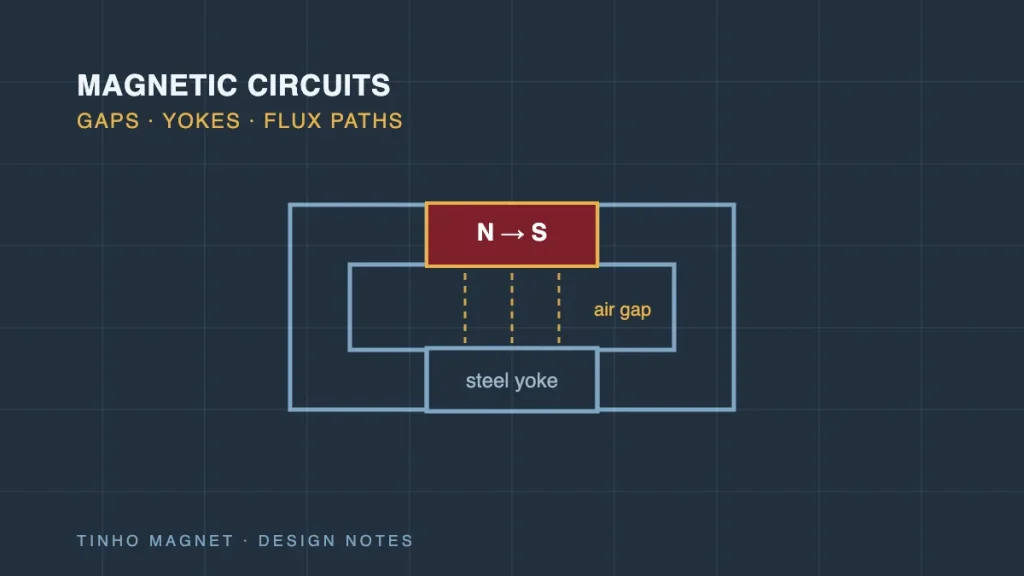
Here is the highest-leverage secret in magnet engineering: the magnet is only half the design. The other half is everything around it — the steel, the gaps, the geometry that decides where flux actually goes. Two products with identical magnets can differ in useful force by a factor of three, purely on circuit design. This is the beginner’s map.
Flux behaves like a lazy current
Magnetic flux always closes in loops from N back to S, and it strongly prefers easy paths: steel conducts flux hundreds of times better than air. Sketch any magnet system as a circuit — the magnet is the battery, steel is copper wire, air gaps are resistors — and most design intuition follows immediately. Waste flux through long air detours, and the working gap starves.
The three components
- The air gap is where flux does its job — holding, sensing, driving a coil. Everything else exists to feed it. Gaps are precious: force falls steeply as a working gap widens, which is why a coat of paint measurably weakens a holding magnet.
- The yoke (back iron) is the return road. A steel path behind and around the magnet carries flux home nearly for free, so almost none is wasted on the back side. This one part is the biggest cheap upgrade in magnetics.
- The pole pieces shape and concentrate. Steel narrowing toward the gap squeezes the same flux through less area — higher density where it counts, the principle inside every strong holding assembly.
Three classic circuits
- Open magnet. A bare block in air — flux sprawls everywhere, force is modest, and thin shapes flirt with the self-demagnetization knee. Fine for cat-eye wands and fridge duty; wasteful for machines.
- Pot magnet. The same block inside a steel cup: the cup returns flux and delivers all of it to one face. Holding force multiplies several-fold from one stamped part — the everyday miracle of fixtures and mounts.
- Gap machine. Motor and sensor circuits: magnet, yoke and a defined working gap in series. Here the working point on the B–H curve is set deliberately, and grade choice follows the circuit — not the other way around.
And when the design cannot afford iron at all, there is the elegant exception that carries its own return path: the Halbach array.
What this means for your RFQ
Tell us the circuit, not just the magnet. “N42 disc, 20×5” is a part; “needs 4 kg on 3 mm mild steel through a 0.5 mm plastic wall” is a design brief — and briefs let us propose the pot, the pole piece or the smaller-but-better-circuited magnet that saves real money. Our engineers do this daily: describe the job, sketch welcome.
FAQ
Does the yoke steel type matter?
Mild low-carbon steel is the workhorse — cheap and high-permeability. Stainless grades vary wildly (304 is barely magnetic); hardened steels saturate differently. Say “yoke” in your RFQ and we will spec it with the magnet.
How thick should back iron be?
Thick enough not to saturate — undersized yokes choke flux like a thin wire chokes current. A practical rule: match the yoke cross-section to carry the magnet’s full flux; we calculate it as part of a quote.
Can a circuit be too good?
Yes — a closed loop with no working gap does nothing useful, and over-concentrated poles can saturate steel or push working points somewhere unsafe. Circuits are tuned, not maximized.