
EV Traction Motors: Why NdFeB Powers New Energy Vehicles
One to three kilograms of the most engineered NdFeB on Earth per car. Rotor life at 180 °C, grain-boundary diffusion, and what EV discipline teaches everyone.
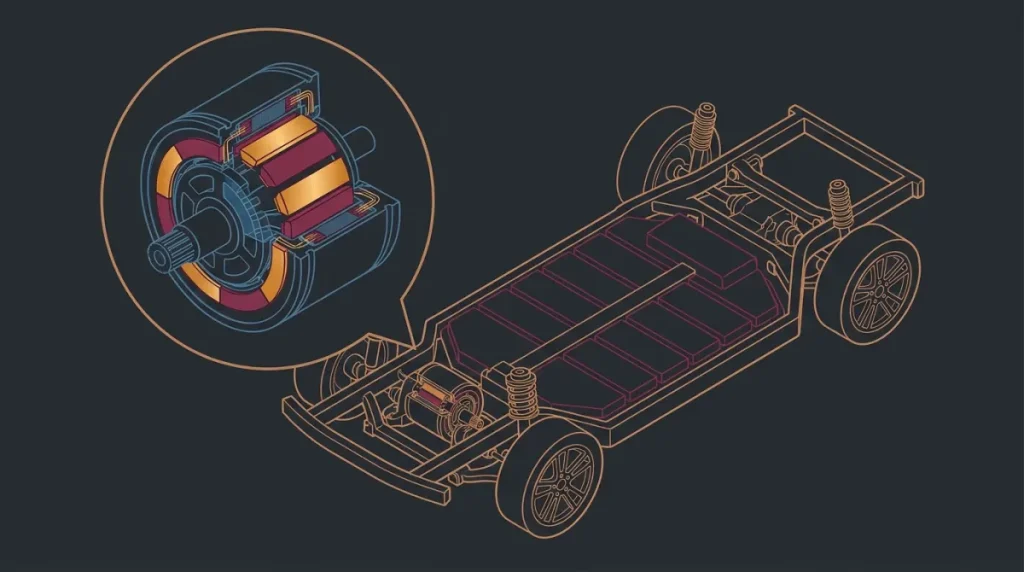
Every electric vehicle rolling off a line today carries roughly one to three kilograms of the most heavily engineered NdFeB on the planet. The traction motor is the harshest, most valuable seat a magnet can occupy — and the requirements written for it are quietly rewriting standards for the whole industry.
Why EVs choose permanent magnet motors
Induction motors work fine — some EVs use them — but permanent magnet synchronous motors (PMSM) win the mainstream because rotor flux is free: no rotor current, no rotor copper loss. That gap in efficiency, a few percent, converts directly into range per kilowatt-hour — the metric the entire car is designed around. The magnet, in effect, is a range extender that weighs a kilogram.
Life inside a traction rotor
| Condition | Typical reality | Consequence for the magnet |
|---|---|---|
| Temperature | 140–180 °C continuous zones | SH/UH-class coercivity mandatory |
| Opposing field | Full winding attack on short-circuit faults | HcJ margins set by the fault, not the drive cycle |
| Speed | 15,000+ rpm rotors | Magnets retained in laminate pockets (IPM), sized against stress |
| Lifetime | 15 years, ~300k km | Zero irreversible loss allowed — validated, not hoped |
The interior-magnet (IPM) layout most EVs use buries rectangular magnet blocks in slots inside the laminated rotor — a V or double-V per pole. Buried magnets gain mechanical safety and reluctance torque; the price is exacting block dimensions, since every micron of slot clearance is either assembly headache or performance loss.
The dysprosium story
High-temperature coercivity traditionally came from dysprosium — scarce and costly. Modern EV magnets use grain-boundary diffusion: heavy rare earth applied to finished magnets diffuses along grain boundaries, hardening exactly where demagnetization starts, with a fraction of the Dy. The result: N-grade strength with SH-plus survival — the technology behind every current traction magnet spec, and increasingly available down the market.
What EV-grade discipline means for everyone
Automotive quality systems — PPAP-style approvals, statistical flux control, full traceability from alloy lot to rotor serial — set the bar our industry now measures itself against. The same rigour is what keeps a small BLDC rotor consistent and a robot joint honest. Traction-adjacent RFQs — pumps, compressors, e-axle auxiliaries — are quoted daily here: bring the fault condition and hot spot, and see the NdFeB range.
FAQ
Why do some EVs use no magnets at all?
Induction and wound-rotor machines dodge rare-earth cost and supply questions at some efficiency cost. Many platforms mix: magnet motor on one axle for range, induction on the other for burst power.
What is the difference between surface and interior magnets?
Surface-mounted magnets (SPM) glue arcs to the rotor surface — simple, great at moderate speed. Interior magnets (IPM) sit inside slots — mechanically safe at high rpm and add reluctance torque. EV traction is IPM territory.
Will EV magnets be recycled?
At fleet scale, yes — kilogram-class uniform magnets per vehicle are exactly the feedstock recyclers want, and recovery chains are forming alongside battery recycling.