
What Is a Halbach Array? One-Sided Flux, Explained Simply
Rotate each magnet 90° from its neighbour and the field piles up on one side while the other goes quiet — no power required, just geometry.
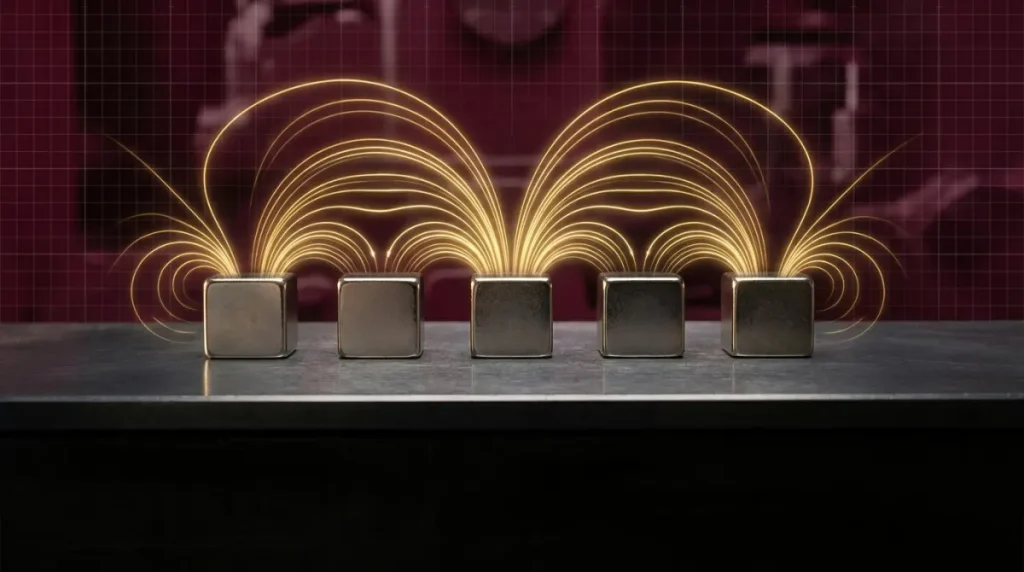
A Halbach array is a row of permanent magnets whose magnetization directions rotate step by step — and the result looks like a magic trick: the magnetic field piles up on one side of the row and almost vanishes on the other. No electronics, no power, just geometry.
How the trick works
Picture five cube magnets in a row. In a conventional array they all point the same way — say, straight up — and the field spreads symmetrically: just as strong below the row as above it. In a Halbach array each block is instead rotated 90° from its neighbour, following the repeating sequence → ↑ ← ↓ →.
That small change re-routes everything. The flux of the horizontal magnets travels sideways through the array, joining the vertical magnets’ loops on one face and opposing them on the other. Real engineered arrays typically achieve about 1.4× the field of a same-mass conventional array on the working side — while the back side drops to near zero.
Why does rotating magnets do this?
Think of each magnet as a source of flux loops. The vertical blocks push flux out of the face; the horizontal blocks lay a return path inside the row. On the strong side the two contributions add; on the weak side they oppose. The array is, in effect, its own flux-return yoke — the iron structure a conventional magnetic circuit needs to guide flux home — which is why Halbach machines can skip heavy back-iron entirely.
Where one-sided flux earns its keep
- Motor and generator rotors. More torque per gram — the field concentrates where the windings are, and the rotor needs less iron. Valuable anywhere weight matters.
- Maglev and linear stages. The classic demonstration: strong lift on one face, minimal stray field on the other.
- Sensors and encoders. A clean, strong sinusoidal field on the working side improves signal quality.
- Magnetic separators and couplings. Reach deeper into the working zone with the same magnet mass.
- Wireless charging alignment. Ring-shaped rotating-magnetization designs put the holding force exactly where the coil needs it.
Why Halbach arrays are hard to build
Here is the part datasheets do not show: assembling one is a wrestling match. Each block must be glued in a position where its neighbours are actively trying to flip it — the torques are large, the tolerances tight, and a mis-seated block quietly costs you field uniformity. Doing this repeatably takes purpose-built fixtures, magnetized-state machining know-how, and patient QC: flux mapping across the working face, not just a single gauss reading.
This is a speciality of ours. We build custom Halbach magnet arrays — linear rows, arcs and full rings — from single prototypes to production volumes. If you are weighing a Halbach design against a conventional magnet-plus-yoke layout, send us the working gap and target field; we will tell you honestly which one wins for your case.
FAQ
Who invented the Halbach array?
Physicist Klaus Halbach described the arrangement in the early 1980s while designing particle-accelerator magnets at Lawrence Berkeley Laboratory. The one-sided-flux idea had been noted earlier by John Mallinson, who called it a “magnetic curiosity”.
How much stronger is the strong side?
An idealized infinite array cancels the weak side completely and boosts the strong side by √2 ≈ 1.4× versus a conventional array of the same magnet mass. Finite, real-world arrays come close, with some leakage at the ends.
Can a Halbach array be circular?
Yes — Halbach rings and arcs concentrate flux inward or outward and are the basis of high-performance motor rotors and couplings. Segment count and magnetization accuracy decide how clean the field is.