
Magnets for BLDC Motors: A Selection Guide
Torque density, stall survival, arc geometry and batch consistency — what brushless motors demand from their rotor magnets, from the supplier side.
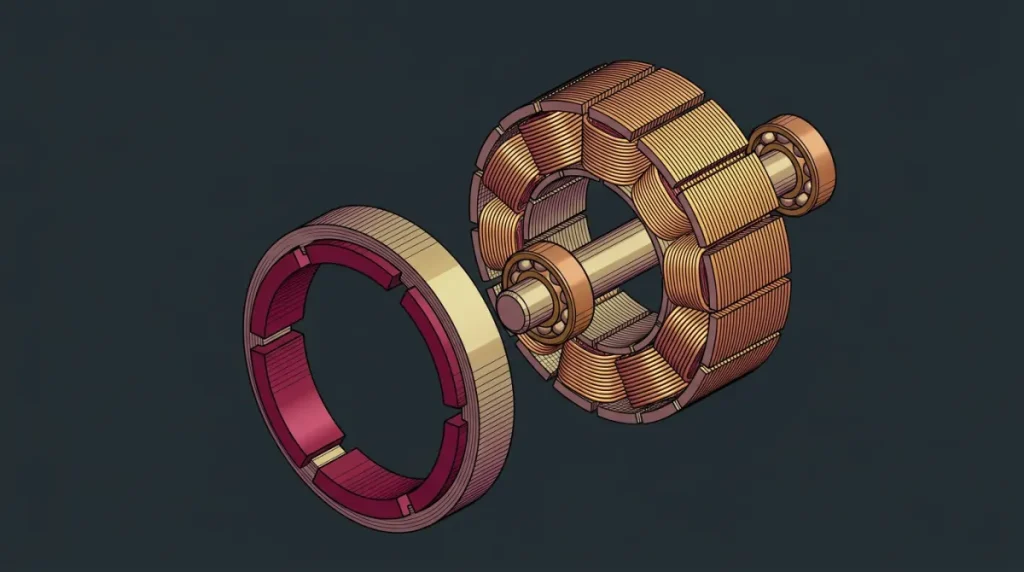
Brushless DC motors are eating the world of small machines — drones, fans, e-bikes, power tools, appliances. Every one of them carries a ring of permanent magnets at its heart, and motor engineers judge those magnets by standards holding-magnet buyers never meet. Here is the selection logic, from the supplier side.
What the rotor magnets actually do
In a BLDC machine the windings stay still and the magnets move. The stator fires timed field pulses; the rotor magnets chase them. Torque is set by the product of winding current and rotor flux — so every extra tesla the magnets deliver is torque you did not pay for in copper heat. That is why NdFeB conquered this category: more flux from thinner magnets means smaller, cooler, lighter machines.
The four demands motors make
- High flux (Br). Torque density is the whole sales pitch. N42–N52 territory in compact motors.
- Demagnetization survival (HcJ). A stalled or shorted motor throws its full winding field against hot magnets. This is the classic case where temperature class is chosen by the fault condition, not normal running: H and SH dominate serious designs.
- Geometry: arcs and rings. Surface-mounted rotors want thin arc segments with precise curvature; small rotors often take one diametrically magnetized ring instead. Segment fit decides air-gap uniformity, and the air gap decides everything.
- Batch consistency. Cogging and vibration follow from magnet-to-magnet variation. Serious motor builders specify flux tolerance per segment — and test incoming lots.
Common formats we supply
| Motor style | Magnet format | Typical grades |
|---|---|---|
| Drone / fan outrunner | Thin arc segments, 0.8–2 mm wall | N48–N52, H |
| Small inrunner | Diametric ring or 2–4 pole ring | N42–N48, M/H |
| Power tool | Arc segments | N45–N52, SH |
| Appliance / pump | Ferrite ring or NdFeB ring | Y30–Y35 / N38–N42 |
Note ferrite’s survival in cost-driven pumps and fans — the material trade-off is alive and well inside motors.
Getting a motor magnet quoted properly
Send the arc drawing (or ring size), the pole count, the magnetization direction, the worst-case rotor temperature and the fault field if you know it. With those five facts we can quote grade options the same day — browse the NdFeB range or go straight to an engineer.
FAQ
Why do some rotors use one ring instead of arc segments?
Below roughly 30 mm diameter, a single multipole or diametric ring is cheaper to make and assemble than tiny arcs, and pole accuracy comes from the magnetizing fixture instead of segment placement.
What kills motor magnets most often?
The stall-plus-heat combination: full winding current at standstill, rotor already hot. Grades are chosen to survive that transient, not the average duty.
Glue or mechanical retention?
Both, usually: adhesive for assembly and sleeve or banding against centrifugal force at speed. High-speed rotors add a stainless or carbon sleeve — worth deciding before the magnet drawing is frozen.