
How to Specify a Custom Magnet: The 8 Parameters We Ask For
Material, grade, size, tolerance, coating, direction, temperature, quantity. Answer eight questions and any competent factory can quote you the same day.
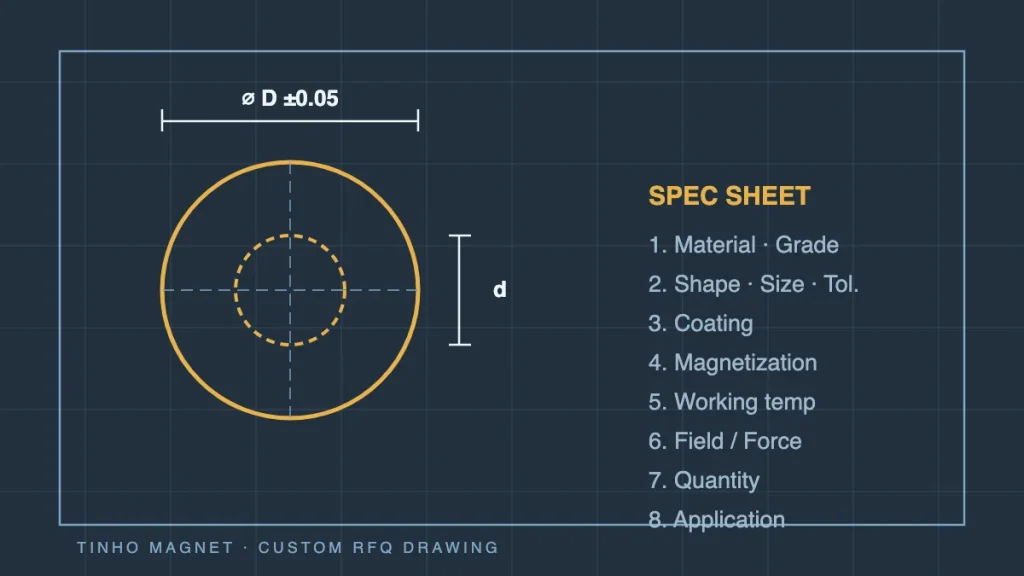
“Can you make this magnet?” Almost always, yes. The real question — the one that decides whether your quote lands in hours or after a week of email ping-pong — is whether the request contains the eight parameters a factory needs. Here they are, in the order we read them.
The eight parameters
- Material. Sintered NdFeB, ferrite, rubber/flexible or bonded SmFeN. If unsure, describe the job — our material guide covers the trade-offs.
- Grade. N35–N54 plus temperature suffix for NdFeB, Y30/Y35 for ferrite. Unsure is fine: give force and temperature, we will propose.
- Shape and dimensions. A drawing beats a description; a STEP file beats both. For simple discs and blocks, D × T or L × W × T with units.
- Tolerances. Standard is ±0.05 mm for ground faces; tighter costs, looser saves. Flag the surfaces that actually matter.
- Coating. NiCuNi is the默认 workhorse; zinc saves cost indoors; epoxy fights salt and chemicals. Say the environment and we will match it.
- Magnetization direction. Axial, diametric, or multipole — and whether parts ship magnetized. This decides fixtures and even feasibility.
- Working temperature. The magnet’s own worst-case spot, not the room. One number prevents the classic summer failure.
- Quantity and cadence. 50 prototypes and 50k/year are different manufacturing problems with different unit prices. Both welcome — say which.
A specification that quotes itself
“Sintered NdFeB N45SH, disc ⌀12 × 3 mm, ±0.05, NiCuNi, axial magnetization, shipped magnetized, working temp ≤120 °C near a motor winding, 2,000 pcs pilot then ~30k/yr.”
That sentence gets a same-day quote from any competent magnet factory on earth. Nothing in it required a lab — just decisions.
What happens when parameters are missing
We do not guess silently; we ask. But every round trip costs a day, and assumptions imposed late cost more: a coating chosen after tooling, a tolerance tightened after quoting, a temperature revealed after the first summer. The eight questions above are cheaper to answer on day one — every time.
Have seven of eight? Send it anyway — start the RFQ and we will fill the gap together. Drawings, sketches and even competitor part photos all work.
FAQ
I only have a competitor’s magnet. Can you copy it?
Usually. We measure geometry and flux, infer grade and coating, and quote an equivalent — plus tell you where the original was over- or under-specified.
Do I need a formal drawing?
No. A dimensioned sketch or clear photo with a ruler covers prototypes. Production tooling deserves a proper drawing, which we can prepare from your sample.
What is your minimum order?
We quote from single-piece prototypes upward. Small batches carry setup cost, but nobody should have to order ten thousand pieces to test an idea.