
What Is Magnetism? From Electron Spin to Industrial Magnets
Magnetism is not a coating or a charge — it is electrons, organized. From spin to domains to the magnetizing pulse, here is the whole story in plain English.
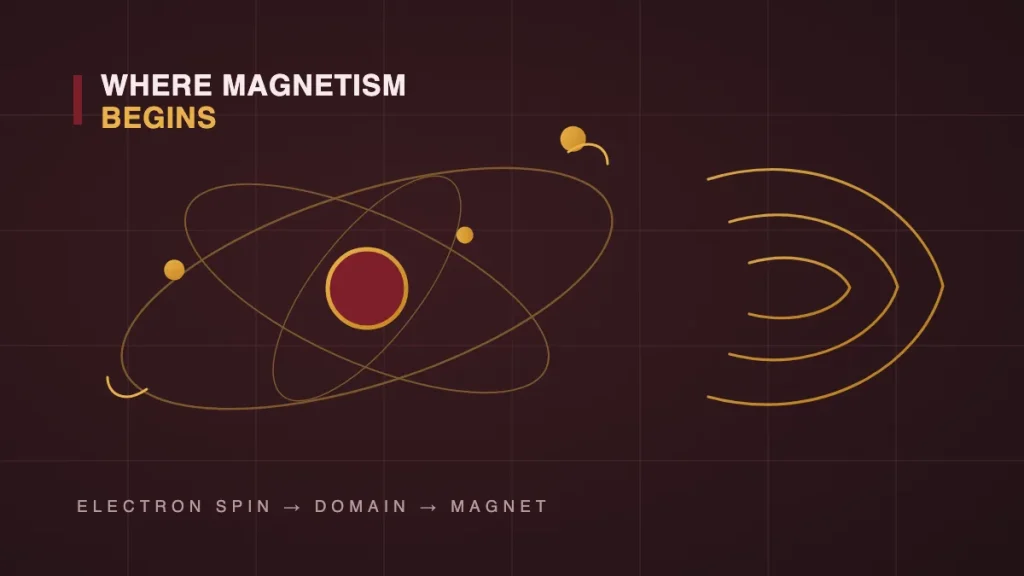
Pick up any magnet in our factory — a sintered disc fresh off the grinding line, a flexible strip, a ferrite block — and you are holding the visible end of a story that starts inside atoms. Magnetism is not a coating, an additive or a charge we inject; it is a property of electrons, organized. Understanding that one idea explains almost everything else about how magnets behave.
It starts with electron spin
Every electron acts like a vanishingly small magnet, thanks to a quantum property called spin. In most materials these little magnets pair up and point in opposite directions, cancelling each other out — which is why your desk, your coffee and most metals are not magnetic. In a few elements — iron, nickel, cobalt and some rare earths like neodymium — unpaired electrons survive, each contributing a tiny magnetic moment that does not get cancelled.
From atoms to domains
Unpaired spins alone are not enough. In ferromagnetic materials the atomic magnets also talk to their neighbours, aligning together across small regions called magnetic domains — each a few micrometres across, each a miniature magnet in its own right. In a fresh, unmagnetized piece of material the domains point every which way, so the whole lump shows almost no external field. All the magnetism is there; it is just disorganized.
Magnetizing = organizing
When we magnetize a part in the factory, we place it inside a coil and hit it with an intense field pulse — tens of thousands of gauss for a few milliseconds. Domains aligned with the field grow; misaligned ones flip. The pulse ends, and the domains stay pointing the same way. That is all a permanent magnet is: a material whose domains have been organized and which is stubborn enough to stay organized.
That stubbornness is the property engineers call coercivity, and it separates a good permanent magnet from a piece of soft iron. Iron is easy to align and easy to scramble; a sintered neodymium magnet resists scrambling by design — heat, opposing fields and time all struggle to undo it.
Why some magnets are so much stronger
Two things decide strength. First, how many unpaired spins the material offers per cubic millimetre — neodymium-iron-boron crystals are exceptionally dense in usable moments. Second, how completely those crystals were aligned during manufacturing. Sintered NdFeB is pressed under a strong magnetic field before sintering, so nearly every crystal grain points the same way when the block solidifies. That built-in crystal alignment is why a small neodymium magnet outperforms a ferrite block many times its size — and why manufacturing process matters as much as chemistry.
The three big consequences for buyers
- Heat scrambles domains. Every magnetic material has a temperature above which thermal jostling defeats alignment. That is why working temperature is one of the first questions we ask.
- Fields fight fields. Put a magnet in a strong opposing field — inside a motor, for example — and poorly chosen material will partially demagnetize.
- Alignment is manufacturing. The same chemical recipe can yield very different magnets depending on pressing, orientation and sintering quality. Supplier discipline shows up in flux consistency.
Curious what organized electrons can do for your product? Browse our magnet range or send us your application — we quote within 24 hours.
FAQ
Why isn’t every metal magnetic?
Most metals have electron spins that pair up and cancel. Only materials with surviving unpaired moments and neighbour-to-neighbour alignment — iron, nickel, cobalt and certain rare-earth alloys — can be permanently magnetized.
Can a magnet “run out” of magnetism?
Not by being used. Holding, lifting or attracting does not consume anything. Domains only lose alignment through heat, strong opposing fields or physical damage.
What is the difference between a permanent magnet and an electromagnet?
An electromagnet borrows its alignment from an electric current and loses it when the current stops. A permanent magnet has the alignment frozen into its crystal structure — no power required.