
Why Magnets Lose Strength: Demagnetization Explained
The culprit is almost never age. Heat, opposing fields, the knee and corrosion — four thieves, four diagnostic patterns, four fixes.
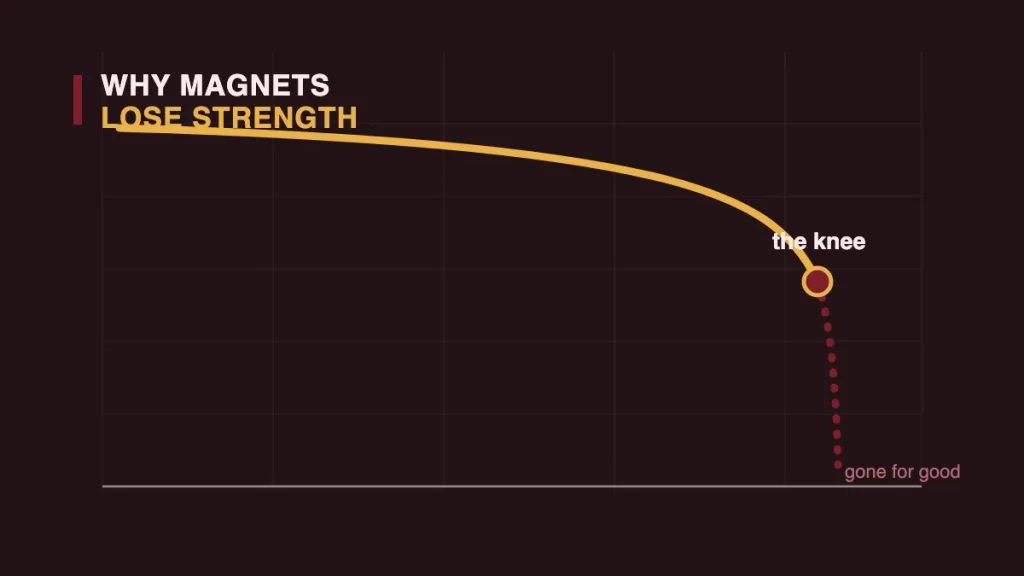
“The magnets got weaker” is the complaint; the culprit is almost never age. Permanent magnets are astonishingly permanent — decades of storage cost fractions of a percent. When strength actually disappears, one of four specific thieves took it. Naming the thief is most of the repair.
Thief 1: heat
By far the most common. Every grade has a temperature ceiling — and, as our temperature guide details, the practical ceiling depends on shape and opposing fields, not just the letter on the datasheet. Below the ceiling losses are reversible; past it the loss is permanent. Diagnosis: weakness after summers, hot processes (soldering near magnets!) or enclosure changes.
Thief 2: opposing fields
A strong external field aimed the wrong way flips domains outright. Sources include neighbouring magnets assembled pole-to-pole, motor winding faults, and magnetizing fixtures nearby. The defence is coercivity — the HcJ from our three-numbers guide — plus layouts that keep opposing fields off the sensitive axis. Diagnosis: sudden loss after a specific assembly step or electrical event.
Thief 3: the knee (self-demagnetization)
Short, wide magnets operate low on the B–H curve. Add a little heat and the working point drops below the knee — the magnet demagnetizes itself, no villain required. The classic case: a coin-thin disc, fine in the office, fading in a warm device. Diagnosis: loss concentrated in thin parts while thicker ones survive.
Thief 4: corrosion and damage
Rust does not just look bad — corroded volume is dead volume, and cracked or chipped magnets lose flux around every fracture. This thief is fully preventable with the right coating and sane handling. Diagnosis: visible surface change accompanies the weakness.
Reading the loss like an engineer
| Pattern | Likely thief | Fix |
|---|---|---|
| Gradual, after warm seasons | Heat | Higher temp class (M/H/SH) |
| Sudden, after assembly/fault | Opposing field | Higher HcJ, layout change |
| Thin parts only | Knee / self-demag | Thicker geometry or better grade |
| With rust, chips, swelling | Corrosion/damage | Coating upgrade, handling rules |
Suffering an unexplained fade? Send two parts — one weak, one spare — and our lab will name the thief from flux curves and surface analysis, usually within days.
FAQ
Can a demagnetized magnet be restored?
If the material is undamaged (heat or field losses), re-magnetizing restores full strength — but the part must come back to a magnetizer. Corrosion losses are permanent.
Do magnets lose strength from use — attracting and releasing?
No. Holding and releasing is not consumption; no energy is drawn from the magnet. Only the four thieves above take strength.
Does dropping a magnet demagnetize it?
The shock itself barely matters at normal scales; the chips and cracks from the impact are the real loss. Treat drops as mechanical damage events.