
Magnet Coatings Guide: NiCuNi vs Zn vs Epoxy vs E-coating
Bare NdFeB corrodes in days — every part wears a coat. Salt-spray numbers, character and choosing rules for the eight standard finishes.
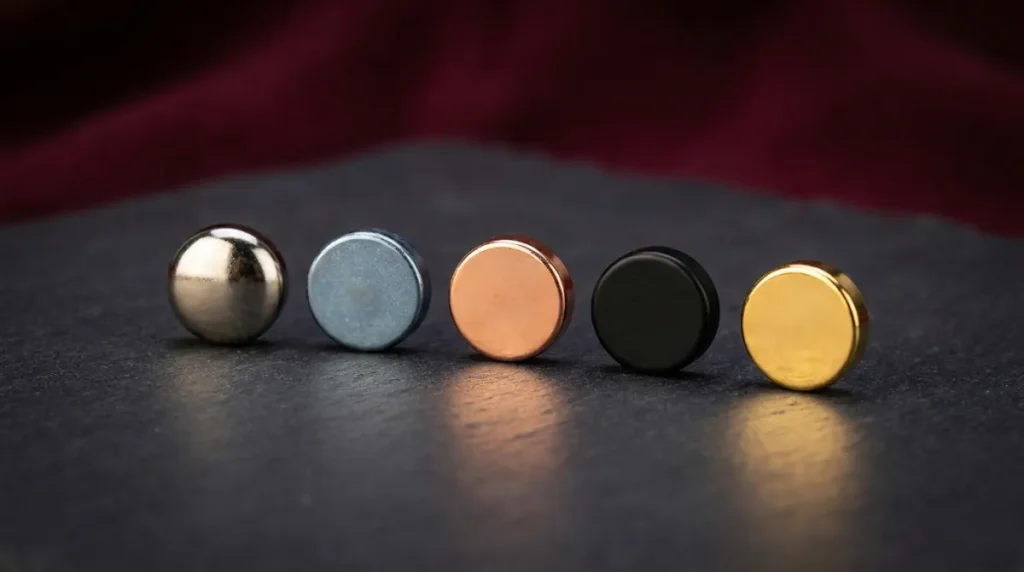
Bare sintered NdFeB has a secret shame: leave it in humid air and it starts corroding within days. The neodymium-rich phase between crystal grains rusts first, the structure loosens, and a magnet can literally crumble at the edges. Every NdFeB part therefore wears a coat — and choosing that coat is a real engineering decision, not a checkbox.
Why NdFeB corrodes at all
The alloy that makes neodymium magnets strong also makes them vulnerable: the grain-boundary phase is chemically active and sits exposed at every surface. Moisture, salt and acids attack it preferentially, undermining grains from between. Ferrite never has this problem — it is already an oxide — which is one of its quiet advantages from our material comparison. NdFeB gets the strength; the coating earns the lifespan.
The working wardrobe
| Coating | Typical salt spray* | Character | Choose when |
|---|---|---|---|
| NiCuNi (nickel) | 48–72 h | Bright, hard, the industry default | General purpose, visible parts |
| Zn (zinc) | 24–48 h | Grey-blue, economical | Dry indoor use, cost-driven |
| Black zinc | ~48 h | Matte black on a budget | Appearance + light duty |
| Black epoxy | 500 h+ | Best barrier, slightly thicker | Salt, humidity, chemicals |
| E-coating | 500–720 h | Uniform electrophoretic film, superb edge coverage | Complex shapes, harsh service |
| Cu / Au / Cr | varies | Base layer / decorative & biocompatible / hard-wearing | Special surfaces |
*Typical hours to first white/red rust in neutral salt spray; actual life depends on thickness and process quality.
Three decisions that pick the coating for you
- Environment. Indoor electronics: NiCuNi or Zn. Bathroom, marine, outdoor, chemical: epoxy or e-coating — no debate.
- Assembly method. Gluing? Epoxy and e-coat bond beautifully; bright nickel sometimes needs surface prep. Press-fitting? Nickel’s hardness survives insertion; soft coatings scratch.
- Tolerance stack. Coatings add 10–25 μm per side. On a ⌀3 mm micro part that is real geometry — specify dimensions after coating, as our RFQ guide recommends.
What separates good plating from cheap plating
Two magnets can both say “NiCuNi” and behave completely differently. The differences hide in preparation (surface cleaning before plating), layer thickness and adhesion. Poor plating blisters at edges, flakes under thermal cycling, and turns salt-spray hours into salt-spray minutes. Our incoming and outgoing checks include thickness measurement and adhesion tests, plus periodic salt-spray sampling — boring, decisive work.
Tell us where the magnet will live — one sentence about the environment — and the coating usually picks itself. The full range is on our NdFeB pages.
FAQ
Which coating is “strongest”?
Coatings do not add magnetic strength — they subtract a little, since coating thickness widens the effective air gap. The thinner the part, the more a thick coat costs you; another reason e-coat’s thin uniformity is prized.
Can magnets be used uncoated?
Only in sealed, dry assemblies with short service expectations — and even then we advise against it. The exception is temporary prototypes, where bare parts save a few days of lead time.
Is nickel plating safe for skin contact?
Prolonged skin contact with nickel can irritate sensitized individuals. For wearables and jewelry-adjacent parts, specify epoxy or gold top-coats.