
Br, HcJ and BHmax: The Three Numbers That Define a Magnet
How strong, how stubborn, how much energy per litre. Learn what each number controls and you can size up any magnet grade in thirty seconds.
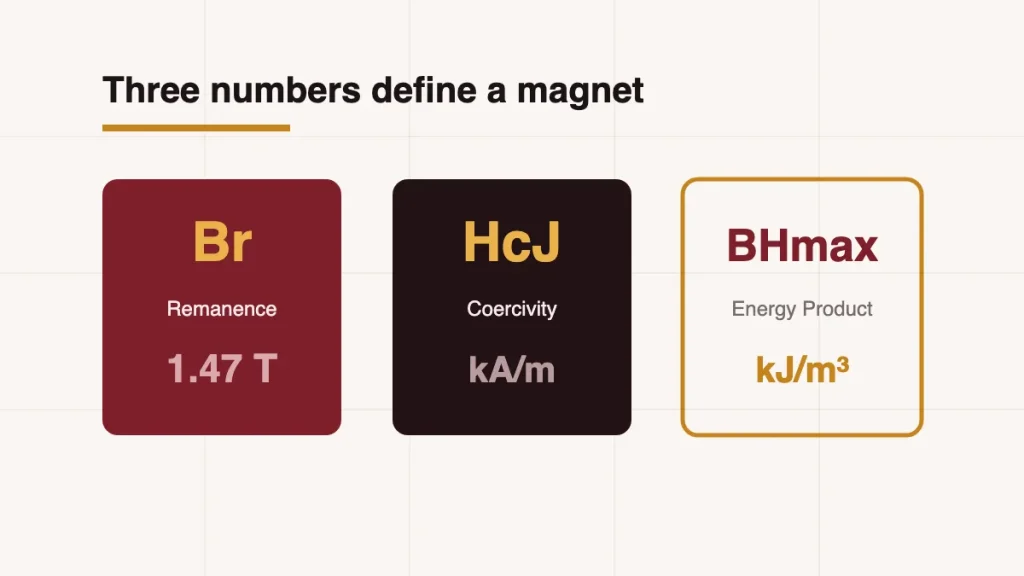
Strip away the footnotes and every magnet datasheet is trying to tell you three numbers. Learn what Br, HcJ and BHmax each control, and you can size up any grade — from any supplier, in any material — in thirty seconds.
Br — how strong
Remanence is the flux density the material holds after magnetizing, measured in tesla. It sets the ceiling on surface field: an N52 at ~1.44 T simply pushes more flux out of the same face than an N35 at ~1.19 T. When customers say “I need it stronger”, nine times out of ten they are asking for more Br — or more magnet length in the flux direction, which is often cheaper.
HcJ — how stubborn
Intrinsic coercivity is the opposing field needed to permanently destroy the magnetization, in kA/m. It never shows up in a holding-force demo, which is why it gets ignored — until summer. Heat lowers HcJ; if the combination of temperature and opposing field crosses what is left, flux dies quietly and permanently. Motor rotors, actuators and anything near coils live or die by this number. The letter suffixes (M, H, SH) are, at heart, HcJ upgrades — as we unpacked on the B–H curve.
BHmax — how much energy per litre
The maximum energy product, in kJ/m³ or MGOe, is the peak of B×H along the curve — the densest magnetic energy the material can put to work. It is the great equalizer for comparing materials: sintered NdFeB reaches ~400 kJ/m³, ferrite about 30. And it names the grades: N42 ≈ 42 MGOe. One number, whole story of “how much magnet am I getting per cubic millimetre”.
Reading the trio together
| If your problem is… | Watch | Typical move |
|---|---|---|
| Not enough force | Br | Higher N number, or longer magnet |
| Weakens when hot | HcJ | Add M/H/SH suffix, keep N number |
| Comparing materials/suppliers | BHmax | Normalize by energy product and price |
The three trade against each other: within one material family, chasing maximum Br usually costs some HcJ and vice versa. That is why “just give me the strongest” is rarely the right specification — as our grade guide shows, the smart pick is the cheapest trio that clears your worst-case working point.
Unsure which number is your bottleneck? Describe the application — takes us minutes to tell you whether you have a Br problem, an HcJ problem, or neither.
FAQ
What is the difference between HcB and HcJ?
HcB (normal coercivity) is where usable output flux reaches zero; HcJ (intrinsic) is where the material itself is demagnetized. HcJ is always the higher number and the one that matters for survival ratings.
Do two magnets with the same BHmax perform identically?
Only in energy density. One can trade Br against HcJ differently from the other — same BHmax, different behaviour in heat or opposing fields. Always read the trio, not one number.
Which number does temperature hurt most?
Both Br and HcJ fall with temperature, but HcJ falls roughly five times faster in NdFeB. That asymmetry is why thermal failures are demagnetization events, not just “weaker while warm”.