
Magnets in Wind Turbines: Direct-Drive Generator Basics
Tonnes of NdFeB per machine, judged on distributions not datasheets. What the heaviest magnet application teaches every buyer.
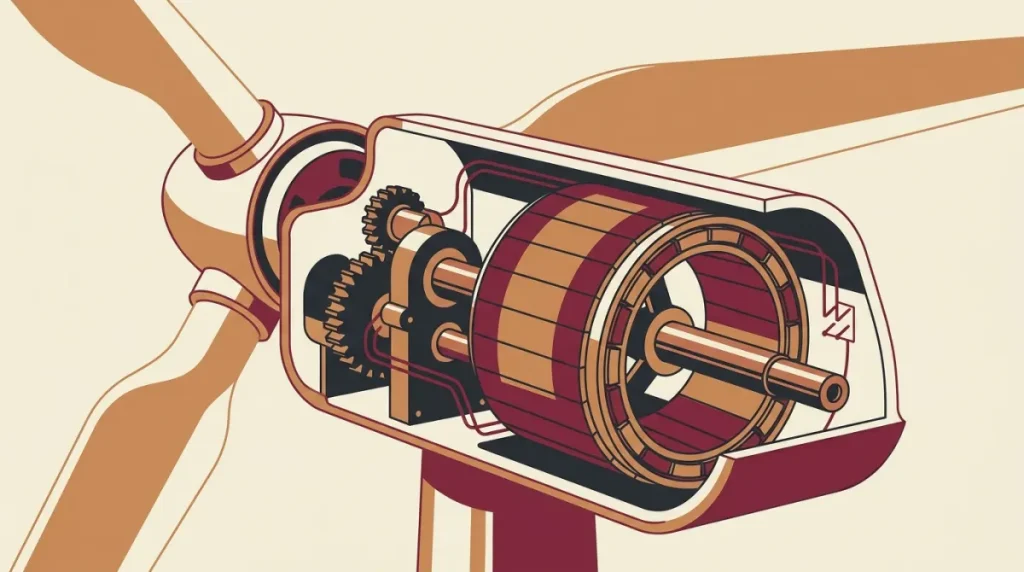
Stand under a modern wind turbine and the numbers stop being abstract: a rotor sweeping more than a football field, a nacelle the size of a bus — and inside many of them, several tonnes of permanent magnets turning wind into grid power. Wind is the heaviest single application for NdFeB on Earth, and it teaches lessons every magnet buyer can use.
Why turbines went permanent-magnet
The traditional turbine used a gearbox to spin a small generator fast. Gearboxes are heavy, maintenance-hungry, and the least reliable large component in the nacelle — a bad trait 100 metres above ground. The alternative: remove the gearbox and let the rotor drive a huge, slow generator directly. Slow rotation demands enormous torque, and torque at low speed is exactly what permanent magnet machines deliver best. PM direct-drive and hybrid designs bought reliability with magnets.
What a turbine generator asks of its magnets
- Sheer quantity, relentless consistency. A single large direct-drive generator carries hundreds of magnet poles. Batch-to-batch flux spread shows up as voltage ripple; suppliers are judged on distributions, not datasheets.
- Serious coercivity. A grid fault can slam a demagnetizing field through the machine while it is hot. High-HcJ grades hold the line — the same HcJ logic as always, at megawatt scale.
- Twenty-year corrosion life. Offshore nacelles live in salt fog. Multi-layer coatings, surface treatments and sealed pole covers together defend the magnet for decades — a job our coatings guide scales up to.
- Assembly-safe formats. Poles are assembled as glued, banded modules because a bare block this size is genuinely dangerous. Handling engineering is part of the product.
The interesting cousin: one-sided flux
Generator designers constantly fight weight at the rim, and some advanced designs borrow the Halbach principle — arranging pole magnetization to concentrate flux toward the windings and thin the back iron. The physics that makes a desk demo delightful saves tonnes at turbine scale.
What this means for everyone else
Most of our customers will never order a tonne of magnets. But wind’s demands — statistical flux control, fault-condition coercivity margins, coatings engineered in decades — define the discipline a good factory practices at every scale. The methods that keep a 6 MW generator honest are the same ones that keep your 6-gram part consistent.
Building anything generator-like, at any size? Browse the NdFeB range or bring us the working point.
FAQ
How many magnets are in one wind turbine?
Direct-drive machines commonly carry one to four tonnes of NdFeB per megawatt of rating — a multi-megawatt generator holds hundreds of pole modules.
Why not use ferrite at this scale, since cost matters?
Some designs do explore it — but ferrite’s tenfold-lower energy density means far more mass at the rim, driving structure and tower costs up faster than magnet savings. NdFeB usually wins the system-level accounting.
Do turbine magnets get recycled?
Increasingly yes — large uniform magnet modules are attractive feedstock for recovery of Nd and Dy, and end-of-life recovery is becoming part of project planning.