
Robot Joint Motors: Magnets in the Humanoid Robotics Boom
A humanoid robot carries 30–50 actuators, and every one is built around NdFeB. What robot joints demand from magnets — from the supplier side of the drawing.
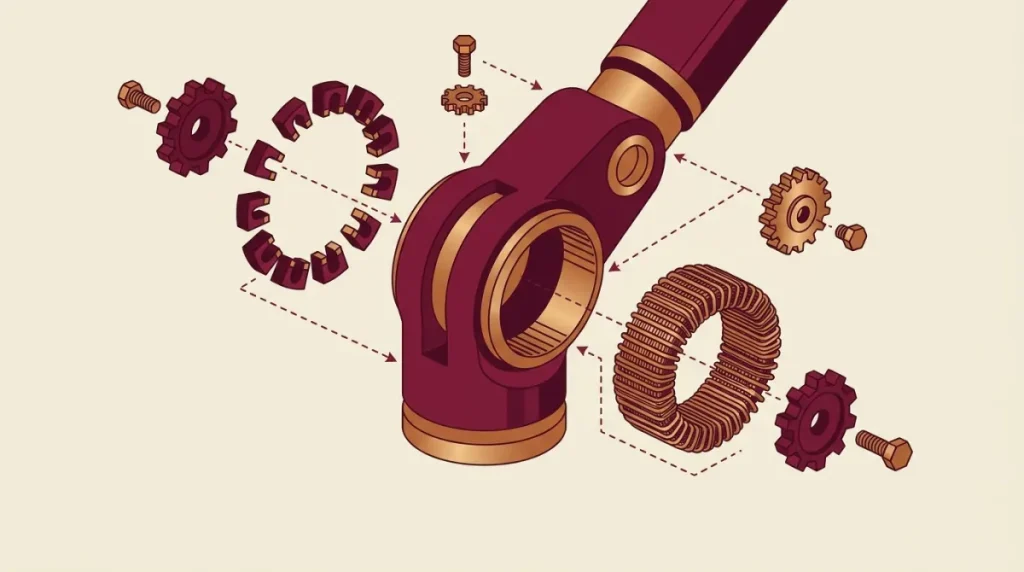
Humanoid robots went from lab demos to funded production roadmaps in barely two years — and every one of them is, magnetically speaking, a walking warehouse. A single humanoid platform carries 30 to 50 joint actuators, and almost every actuator is built around sintered neodymium magnets. Here is what that boom looks like from the supplier side of the drawing.
Where exactly are the magnets in a robot?
- Joint actuators. The workhorse is the frameless torque motor: a thin ring of arc-segment magnets on the rotor, nested inside the joint with a strain-wave (harmonic) gearbox. Hips and knees take the big rings; wrists and fingers take rings smaller than a coin.
- Grippers and end effectors. Compact BLDC and voice-coil designs for fast, controllable pinch forces.
- Sensors everywhere. Every joint needs position feedback — encoder and Hall-sensor magnets, often multipole rings (one face magnetized with alternating N/S poles), one or two per axis.
What robot joints demand from a magnet
Robot joints are among the harshest addresses a magnet can live at:
| Requirement | Why it matters | What it means in spec |
|---|---|---|
| Torque density | Every gram at the wrist multiplies through the arm | N52/N54-class grades, thin-wall arcs |
| Heat endurance | Stall torque at low speed cooks the windings — and the magnets beside them | H/SH coercivity classes |
| Consistency | 30+ actuators must behave identically for control tuning | Tight Br tolerance, per-batch flux testing |
| Precision geometry | Thin arcs in small air gaps; every 0.05 mm of gap is torque lost | Ground surfaces, ±0.02 mm class tolerances |
Some high-end joint designs go one step further and arrange the rotor segments as a Halbach array — concentrating flux toward the windings and shaving back-iron weight. If that term is new, we wrote a plain-English explainer: What is a Halbach array?
The supply-side reality
What robotics customers actually struggle with is rarely the first prototype — it is the hundredth actuator behaving like the first. Thin arc segments crack if machining is careless; coercivity class gets under-specified and joints fade after summer testing; encoder magnets arrive with sloppy pole transitions and the servo hunts. The fixes are unglamorous: magnetized-state grinding, 100 % flux and declination testing, and honest datasheets.
That is the work we do daily. Our factory produces around 600,000 magnets per day across 180+ machines, with in-house slicing, grinding, magnetizing and vision sorting — and our engineering team quotes robot-joint arc segments, sensor rings and Halbach rotor assemblies from your drawing. Explore the neodymium range or talk to an engineer about your actuator design.
FAQ
Which magnet grade do humanoid robot joints use?
Most joint motors specify N48–N54 for torque density, in H or SH coercivity class because stall conditions heat the rotor. The exact pick depends on winding temperature and the safety margin the controller allows.
Why frameless motors instead of complete motors?
A frameless rotor-stator pair integrates into the joint casting, cutting duplicate housings, bearings and length. The trade: the robot maker becomes responsible for the magnetic parts — which is why magnet consistency moves up the priority list.
Are Halbach rotors worth it in robot joints?
They add roughly 10–15 % torque density and reduce back-iron, at higher assembly cost. For weight-critical arms and legs the math increasingly says yes; for stationary cobots a conventional surface-magnet rotor usually wins on cost.