
Magnets in Medical Devices: From Pumps to Imaging
Sealed couplings, sterilization cycles, biocompatible coatings and lot-level traceability — where magnet selection has consequences beyond warranty.
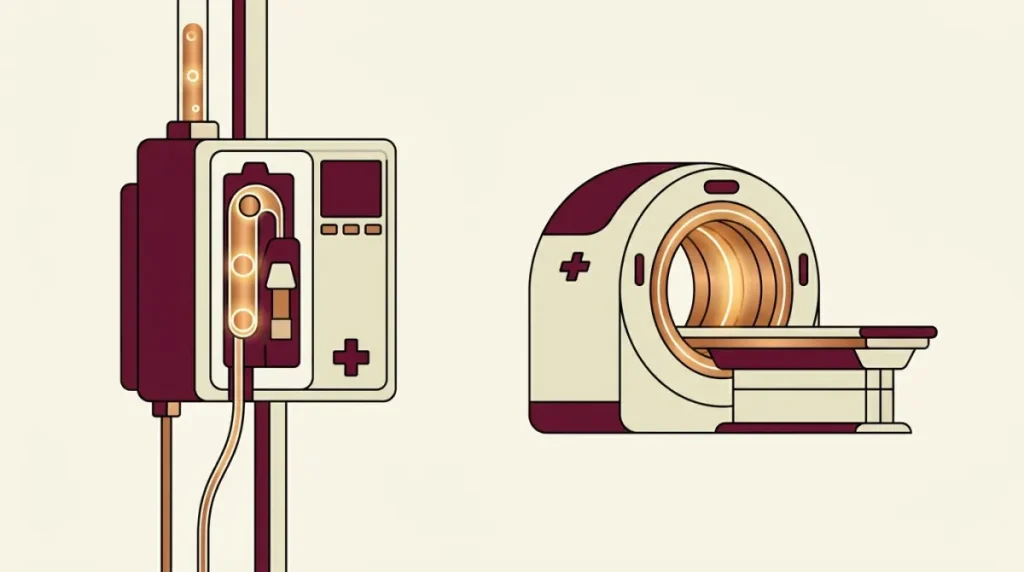
Medicine trusts magnets with jobs it will not give to anything else: coupling pumps through sealed walls, aligning devices through skin, driving quiet motors beside patients. It is a demanding, documentation-heavy field — and one where magnet selection has consequences beyond warranty claims. Here is the landscape.
Where magnets work in medical devices
- Sealed magnetic couplings. Infusion and dialysis pumps must isolate fluid absolutely. A magnet pair coupling torque through a solid barrier wall gives a pump with no shaft seal to leak — the magnet is the sterility strategy.
- Small motors everywhere. Surgical tools, ventilator blowers, lab automation — thousands of precision BLDC-style motors, held to hospital noise and lifetime standards.
- Alignment and closure through tissue or walls. Hearing-device attachments, port locators, cabinet and cover closures on equipment — the silent everyday magnetics of a clinic.
- Imaging adjacency. The MRI machine itself is a superconducting story, but everything designed to exist near one — trolleys, tools, implants — must be engineered for field compatibility, which is its own discipline of avoiding ferromagnetics.
What medical duty changes in the spec
| Concern | Spec consequence |
|---|---|
| Biocompatible contact | Gold or parylene/epoxy top-coats; nickel never touches skin long-term |
| Sterilization cycles | Autoclave = 134 °C steam, repeatedly → H/SH classes and moisture-proof coatings by default |
| Cleanability | Sealed, crevice-free assemblies; e-coat’s uniform film earns its keep |
| Traceability | Lot-level documentation from alloy to shipment — the test-report habit becomes mandatory |
| Reliability | Demagnetization margins validated like automotive practice, because service means recalls |
The sterilization trap
The classic medical-magnet failure is thermal, and it hides in reprocessing rather than use: a device rated for body temperature meets a 134 °C autoclave a thousand times. Standard N-grade magnets fade cycle by cycle — exactly the knee mechanism from why magnets lose strength. The fix costs little at design time: specify the sterilization method in the RFQ and the temperature class follows.
Working with us on medical projects
We supply magnets and magnetic subassemblies to device makers — with material certificates, per-lot flux and coating reports, and NDA-friendly engineering support. We are a component supplier, not the regulatory owner: your quality system leads, our documentation slots in. Describe the device and the reprocessing cycle, and we will spec from there.
FAQ
Are neodymium magnets safe near patients?
Static fields at component scale are considered benign; the practical hazards are mechanical (pinch, ingestion of small parts) and interference with implants like pacemakers — device design manages both with distance and shielding.
What coating is right for skin contact?
Gold over nickel-copper barriers, or full polymer encapsulation. Bare NiCuNi is fine inside housings but not against skin long-term.
Can magnets go inside implants?
Implant-grade applications exist (hearing systems are the famous case) under intense regulatory control and full encapsulation, with MRI-compatibility designed in from day one. That is specialist territory — engage early.