
Gauss vs Pull Force: How Magnet Strength Is Really Measured
Gauss is the field at one point; pull force belongs to the whole setup. Confusing them causes half the mismatched expectations in this industry.
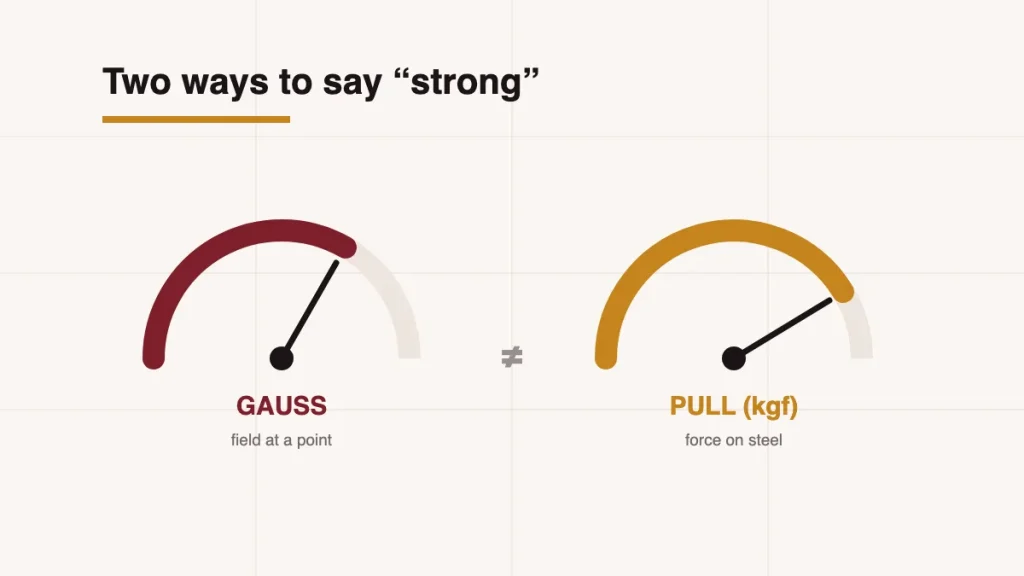
“How many gauss is this magnet?” is the most common question we hear — and the least useful one to ask alone. Gauss and pull force measure genuinely different things, and confusing them is behind half the mismatched expectations in this industry. Five minutes here saves that conversation.
Gauss: the field at one point
Gauss (or millitesla; 1 mT = 10 G) describes magnetic flux density at a specific point in space. A gauss meter’s probe touched to the center of a magnet face reads the surface field right there — and only there. Move the probe a millimetre away and the number drops sharply; slide it toward the edge and it changes again. A surface gauss number without a stated position and geometry is marketing, not measurement.
Pull force: a whole-system number
Pull force — kilograms or newtons to separate the magnet from a steel plate — sounds more practical, and it is, but it belongs to the setup, not the magnet alone: plate thickness and material, surface finish, contact area, direction of pull, even air gaps from paint. The same magnet can pull 5 kg on thick ground steel and under 2 kg on a thin painted panel. Neither number is a lie; they describe different systems.
Why a stronger “gauss” can pull less
A tall, narrow cylinder posts a high center gauss but touches little steel; a wide, thin disc reads lower at the center but grips with far more area. Which one “wins” depends entirely on which number you measure — a classic trap when comparing suppliers’ datasheets. The honest way to compare materials is the trio of Br, HcJ and BHmax from our three-numbers guide; the honest way to compare parts is a defined test setup.
Which number should you specify?
- Holding applications (latches, fixtures, closures): specify pull force with the test conditions — plate spec, gap, direction.
- Sensing and field-driven designs (motors, sensors, couplings): specify flux density at the working point — distance and position defined.
- Material comparisons: use grade properties (Br/HcJ/BHmax) and read the B–H curve, not single-point gauss.
Our lab measures both ways — gauss mapping and calibrated pull tests — and every quote can include the numbers measured the way your application uses them. Describe the job and we will measure what matters.
FAQ
Is a 3000-gauss magnet strong?
Unanswerable as asked. 3000 G at the surface center of a large block is modest; the same reading on a ⌀2 mm micro disc is excellent. Position, geometry and application decide what the number means.
Why do sellers’ pull force claims vary so wildly?
Because the test setup is the hidden variable: thick polished steel and axial pull flatter the number. Ask for the test conditions; a serious supplier states them without being asked.
Can I convert gauss to pull force?
Only roughly, with geometry known (F ≈ B²A/2μ₀ under ideal contact). Treat any conversion as an estimate; measure when the number matters.