
Cat-Eye Nail Magnets: How Magnetic Gel Polish Works
The little wand in the salon is real magnetics: field lines aligning iron particles in wet gel, frozen by UV light. The physics of the cat eye, from a magnet factory.
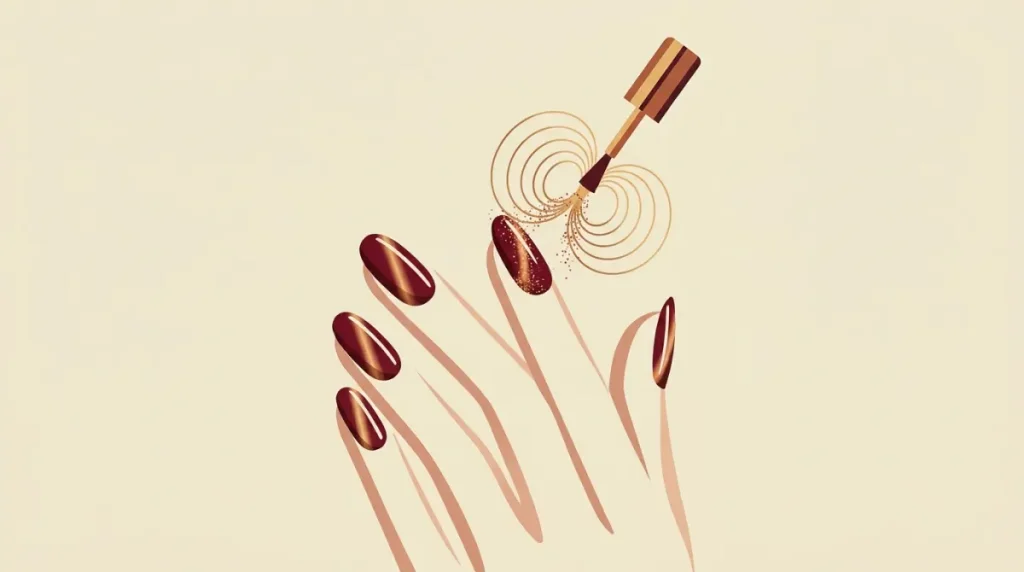
Of all the places our magnets end up — motors, sensors, machines — the most unexpected order we fill is also one of the most delightful: the little wand in a nail salon. Cat-eye gel polish is a genuine magnetic material system, and the physics in that bottle is the same physics we run in the factory, just wearing better colors.
What is actually in the bottle
Cat-eye gel is ordinary UV gel polish loaded with micrometre-scale magnetic particles — iron oxide or coated iron flakes, a few percent by weight. Wet gel lets the particles move; UV curing freezes them wherever they happen to be. The entire trick lives in the thirty seconds between painting and curing.
The wand writes, the lamp saves
Hold a magnet a few millimetres above the wet nail and every particle aligns along the local field lines — exactly the behaviour we explained in what is magnetism, performed in miniature. Where particles stand edge-on they catch light; where they lie flat they go dark. The result is that liquid band of light — the “cat eye” — that follows the field pattern of whatever magnet you used:
- A straight bar magnet draws the classic single stripe.
- A diametric rod curves the stripe — the same magnetization directions logic that steers motor fields, steering glitter instead.
- Double-pole and shaped wands write V-lines, halos and “galaxy” swirls; 9D gels use spherical particles for a softer, deeper glow.
Then 30–60 seconds under the LED lamp locks the pattern permanently. No power, no maintenance — a magnetic recording you wear.
What separates a good cat-eye wand from a fridge magnet
| Property | Why it matters on a nail |
|---|---|
| High grade (N45–N52) | Effect strength falls off steeply with distance; a weak magnet makes a blurry eye |
| Field shape, not just strength | The stripe is a picture of the field — edge geometry and pole layout are the design |
| Small and handleable | Artists work 3–5 mm above the nail, one-handed, for hours |
| Consistent from piece to piece | A salon chain’s look must reproduce across hundreds of wands |
We machine and magnetize wand magnets in bars, discs, rods and custom multi-pole layouts — the same sintered NdFeB that drives industry, dressed for beauty retail. Brands typically private-label a wand set alongside their gel line; tell us the pattern you want the gel to draw and we will shape the field that draws it.
FAQ
Why does the effect only work before curing?
Particles can only rotate while the gel is liquid. UV curing cross-links the resin and locks every particle in place — which is also why the finished nail is completely unaffected by everyday magnets.
Is it safe to hold a strong magnet near fingers?
Yes — the field is static and harmless to tissue. The practical cautions are pinching (strong small magnets snap together fast) and keeping distance from cards and pacemakers, as with any NdFeB part.
Why do some gels give a sharper line than others?
Particle size, shape and loading differ between formulas. Flake particles give crisp mirror lines; spherical “9D” particles give soft, dimensional glows. The wand and the formula design the look together.